Research Question Generator
Enter your research topic and field — get targeted, well-formed research questions for essays, theses, dissertations, and academic papers
How to Use the Research Question Generator
Three steps from a broad topic to focused, researchable questions
Describe Your Research Topic
Enter a clear description of your research topic in the text field. The more specific you are, the more targeted your questions will be. Instead of 'climate change,' try 'the impact of urban heat islands on public health outcomes in low-income neighborhoods.' Then select your academic discipline from the dropdown — the AI uses this to apply field-appropriate framing and terminology.
Choose Your Question Type and Level
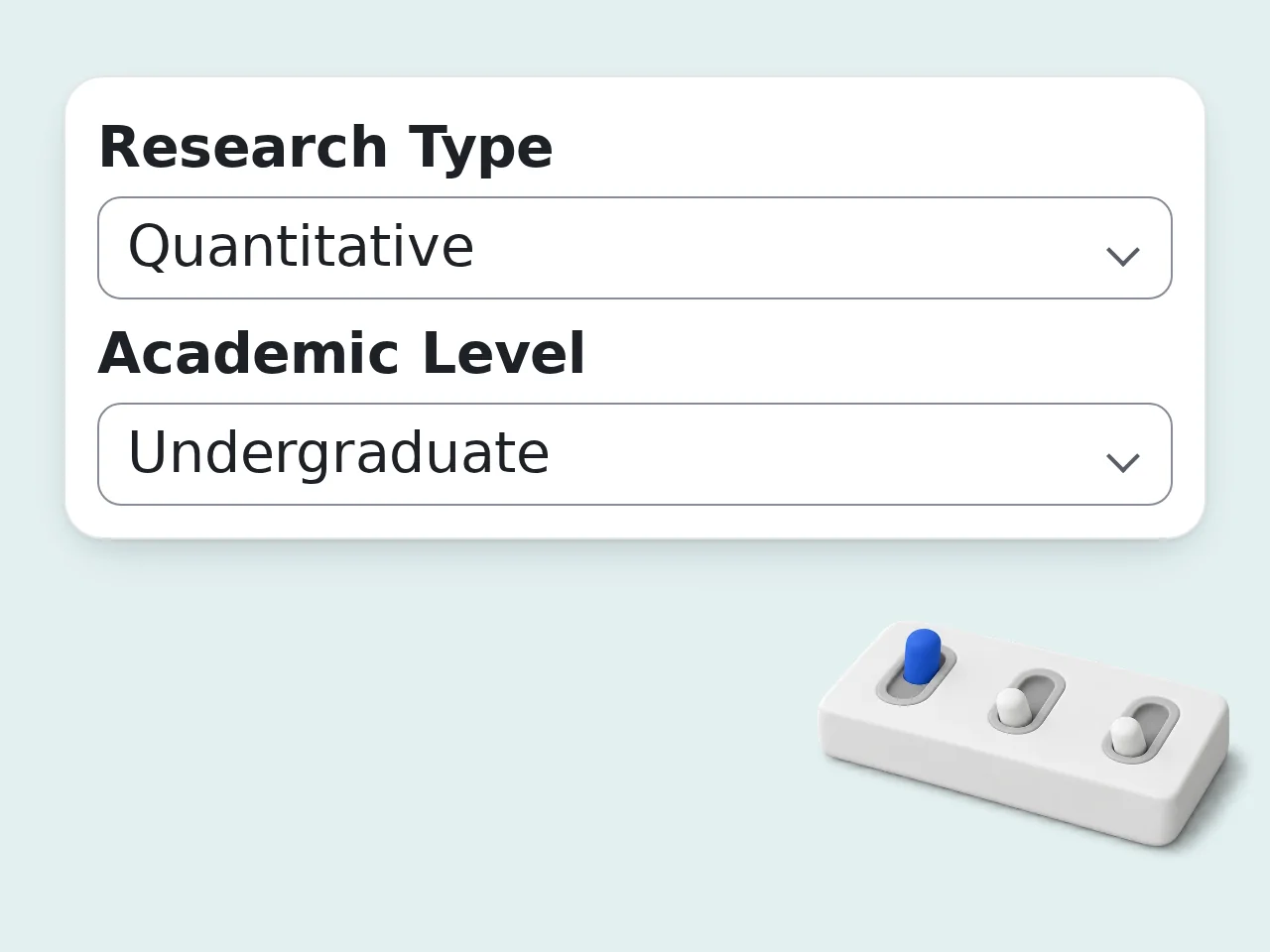
Select the question type that matches your intended methodology: Descriptive for mapping phenomena, Comparative for analyzing differences, Correlational for exploring relationships, Experimental for testing causal effects, Exploratory for open-ended inquiry, or Evaluative for assessing programs or interventions. Optionally set your academic level, scope, and how many questions you want generated.
Review, Copy, and Refine
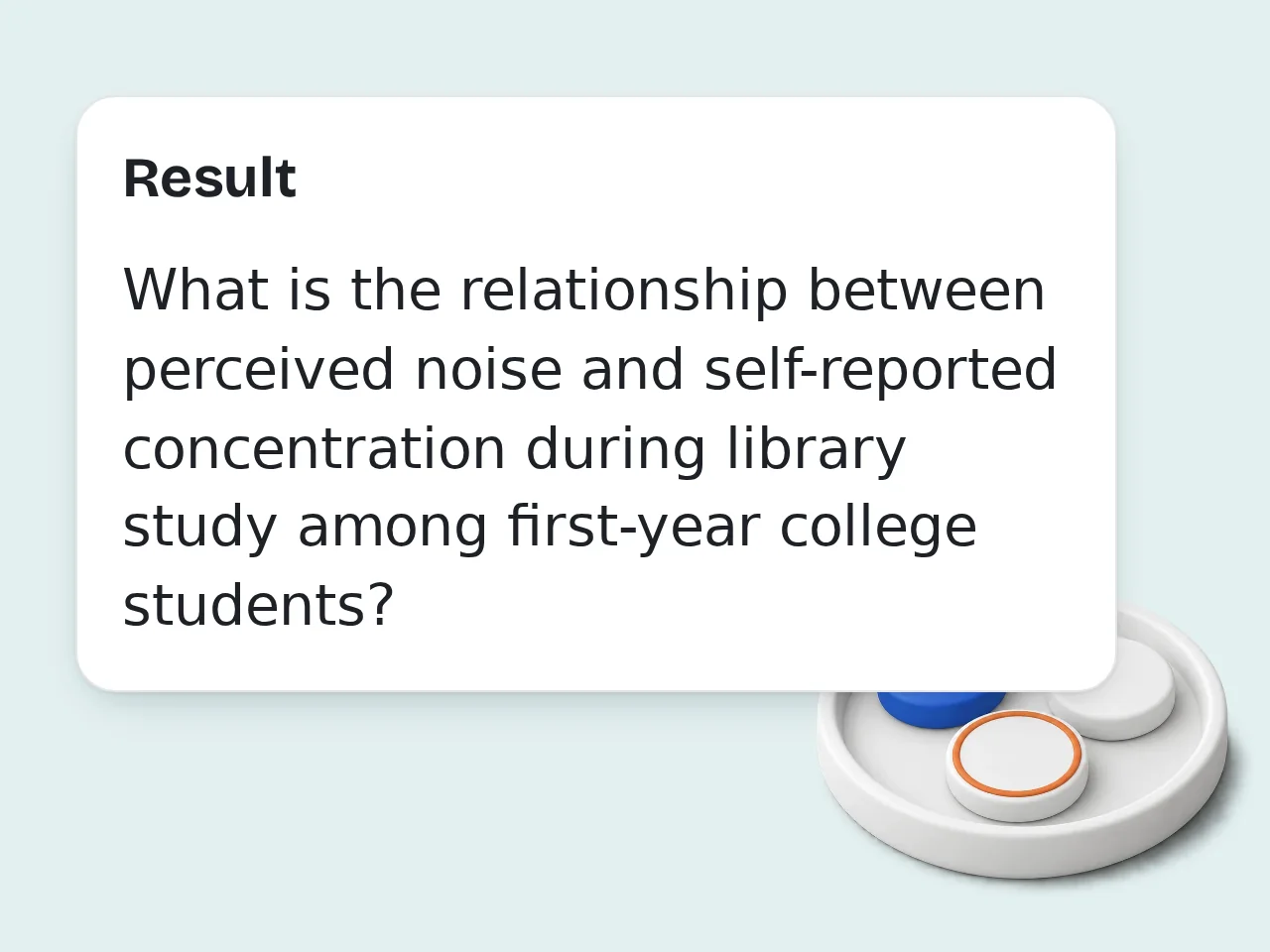
Click Generate and your research questions appear in seconds. Review them for fit, copy the most promising ones into your document, or refine your topic description and regenerate to explore other directions. You can also switch question types to see how the same topic translates across different methodological approaches.
Key Features of the Research Question Generator
Built to produce questions that are focused, researchable, and academically sound
Six Question Type Frameworks
Choose from Descriptive, Comparative, Correlational, Experimental, Exploratory, and Evaluative question types. Each framework shapes the structure and intent of the output. A correlational question reads very differently from an experimental one — the AI applies the correct academic framing automatically so every generated research question matches the methodology you plan to use.
Academic Level Calibration
Set your level from Undergraduate to Doctoral and the AI adjusts the depth, specificity, and theoretical grounding of each question. Undergraduate questions emphasize clarity and manageability; doctoral questions demand originality, nuance, and contribution to the field. This research topic question generator adapts to wherever you are in your academic journey.
Instant, Editable Output
Your research questions appear within seconds of submitting your inputs. Generate three, five, eight, or ten questions at once. Copy them directly into your research proposal, thesis outline, or assignment document, or adjust the topic and regenerate to explore different angles. Most researchers land on usable questions after one or two generations.
Research Question Generator FAQs
Common questions about generating research questions with AI
What is a research question generator?
A research question generator is an AI tool that produces focused, well-structured research questions from the details you provide — your topic, academic field, question type, and level. You fill in a short form and the AI generates ready-to-use research questions in seconds, calibrated to your methodology and academic context. Think of it as a structured brainstorming partner: the AI handles the initial framing so you can focus on evaluating and refining the questions that best fit your study.
How do I use this research question generator?
Enter a description of your research topic in the text area, then select your academic discipline and question type. Optionally set your academic level, scope, and the number of questions you want. Click Generate and your research questions appear within seconds. If the results don't quite match your focus, refine your topic description to be more specific and regenerate. The whole process takes under two minutes, and most users find usable questions after one or two generations.
Is this research question generator free?
Yes, this research question generator is completely free to use. You can generate a full set of research questions without creating an account or entering payment details. Guest users receive a free daily credit allowance shared across tools. Registered free accounts get a higher monthly limit and premium plans provide more monthly credits for users who need repeated access across multiple projects. For most students and researchers working on a single paper or thesis, the free tier covers everything needed.
What are the different question types, and which should I choose?
The generator supports six question types. Descriptive questions ask what a phenomenon looks like or how it is distributed. Comparative questions examine differences between groups, time periods, or contexts. Correlational questions explore relationships between variables without implying causation. Experimental questions test whether one variable causes changes in another. Exploratory questions are open-ended and suited to under-researched topics. Evaluative questions assess the effectiveness or value of a program, policy, or intervention. Choose the type that matches your planned research methodology — each type signals a different analytical approach to reviewers and committees.
What academic levels does this tool support?
The research question generator supports four academic levels: Undergraduate, Master's, Doctoral, and Professional. Selecting your level tells the AI how much theoretical depth, specificity, and originality to build into each question. Undergraduate questions are framed for manageability within a course or semester. Master's questions assume literature familiarity and push toward synthesis. Doctoral questions demand a contribution to knowledge and often require justification of originality. Professional-level questions are suited for applied research, policy work, and industry studies.
How many research questions can I generate at once?
You can generate 3, 5, 8, or 10 research questions in a single run, selectable from the advanced options. For most thesis or dissertation projects, 3 to 5 focused questions are ideal — advisors typically recommend no more than 3 to 5 to keep the study manageable. Generating 8 or 10 is useful when you're in early exploration mode and want to survey the full landscape of possible directions before narrowing down to your primary research question.
Can I use this tool for a thesis or dissertation?
Yes. The research question generator is specifically designed with thesis and dissertation work in mind. Select Doctoral or Master's as your academic level to get questions with the depth and originality those projects require. Use the scope setting to control how broad or narrow the questions are — a dissertation typically needs a narrow, highly specific primary question paired with a few supporting sub-questions. Always review AI-generated questions with your supervisor before committing, as institutional and disciplinary conventions vary.
What academic disciplines does this tool support?
The generator supports eleven academic disciplines: Social Sciences, Natural Sciences, Health & Medicine, Humanities, Business & Economics, Engineering & Technology, Education, Interdisciplinary / Other, Law & Policy, Environmental Studies and Psychology. Selecting the correct discipline ensures the AI applies appropriate terminology, framing conventions and methodological language. A research question in medicine is framed differently from one in sociology, even if the underlying topic is similar.
How is an AI research question generator different from writing questions manually?
Writing a strong research question manually is harder than it appears. Questions must be specific enough to be researchable, broad enough to sustain a full study, and framed in a way that signals the right methodology. AI-generated research questions apply these principles automatically, giving you a structured draft in seconds. Even questions you end up rewriting substantially save time compared to starting from a blank page. The generator is especially useful for spotting framings or angles you might not have considered on your own.
What makes a good research question?
A strong research question is specific, feasible, and significant. It should be narrow enough to be answerable within the scope of the planned study, but meaningful enough that the answer matters to the field. Good research questions are empirically grounded (answerable through data or evidence), avoid yes/no answers unless they are part of a hypothesis-testing design, and are clearly connected to a gap in existing literature. When using a research topic question generator, provide as much specificity as possible in the topic field to get questions that are genuinely researchable rather than broadly thematic.
Can I use this tool for qualitative and quantitative research?
Yes. The question type selection maps naturally onto both paradigms. Descriptive and Exploratory types suit qualitative research, where the goal is rich understanding rather than measurement. Correlational, Experimental, and Comparative types align with quantitative approaches, where variables are measured and analyzed statistically. Evaluative questions can support either paradigm depending on the evaluation design. Select the type that matches your planned methodology and the AI will apply the appropriate framing.
How good are the AI-generated research questions?
The research questions generated by this tool are well-structured, academically framed, and ready to use as a starting point. They follow established conventions for the selected question type and academic level, and avoid common pitfalls like overly broad scope or non-empirical framing. That said, the best research questions require disciplinary expertise and familiarity with the current literature — treat AI output as a high-quality draft, not a final product. Review generated questions against your literature review, refine them with your supervisor's input, and ensure they align with your institution's expectations.
Still have questions?
Contact our support teamGenerate Your Research Questions
Enter your topic and field — get focused, academically grounded research questions in seconds. No account needed.