AI Textbook Summarizer
Turn any textbook chapter into a clear, structured summary instantly
How to Use the AI Textbook Summarizer
Get your textbook summary in 3 simple steps
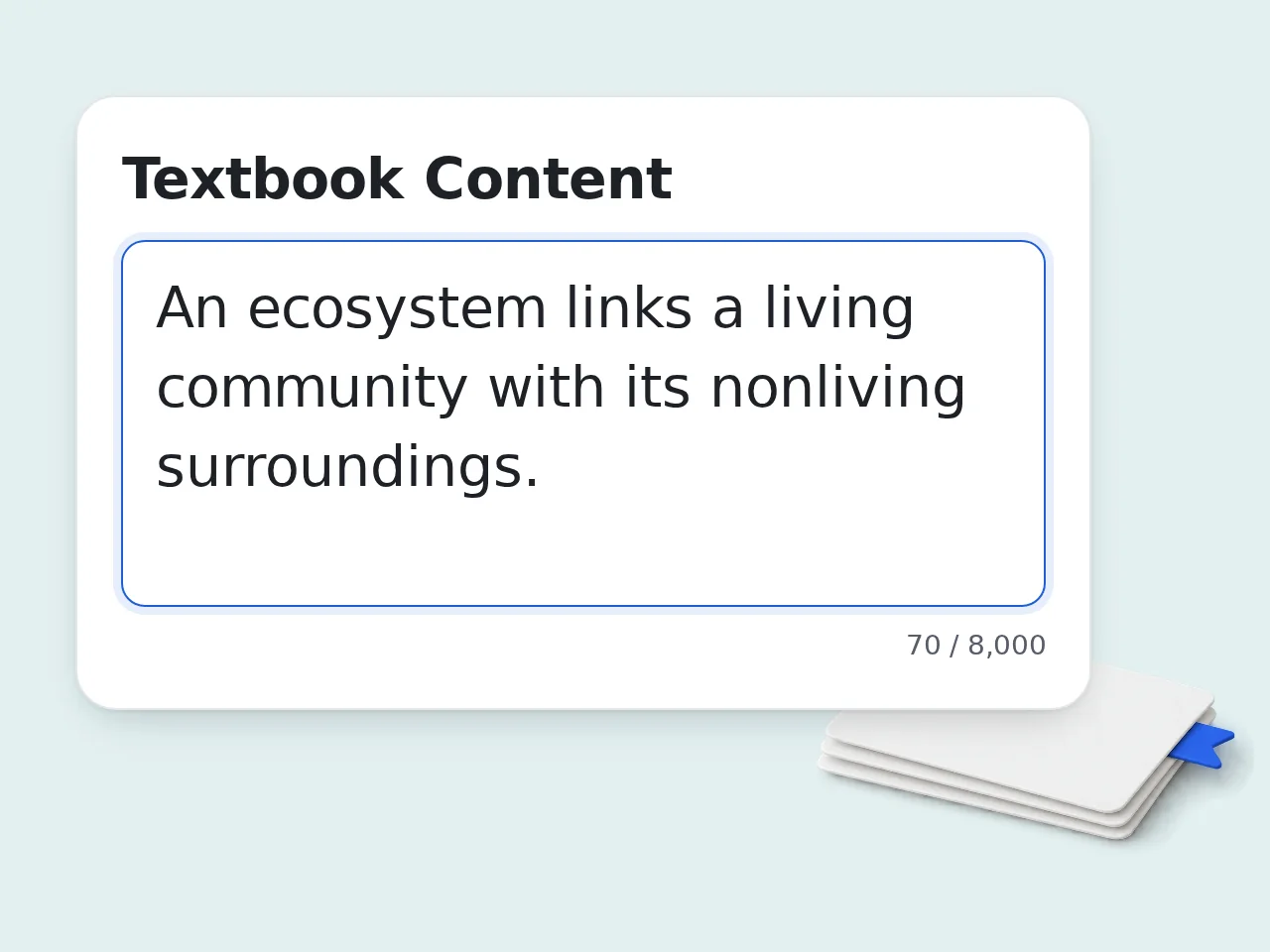
Paste your textbook content
Copy any chapter, passage, or academic text from your textbook and paste it into the input field. No file upload needed.
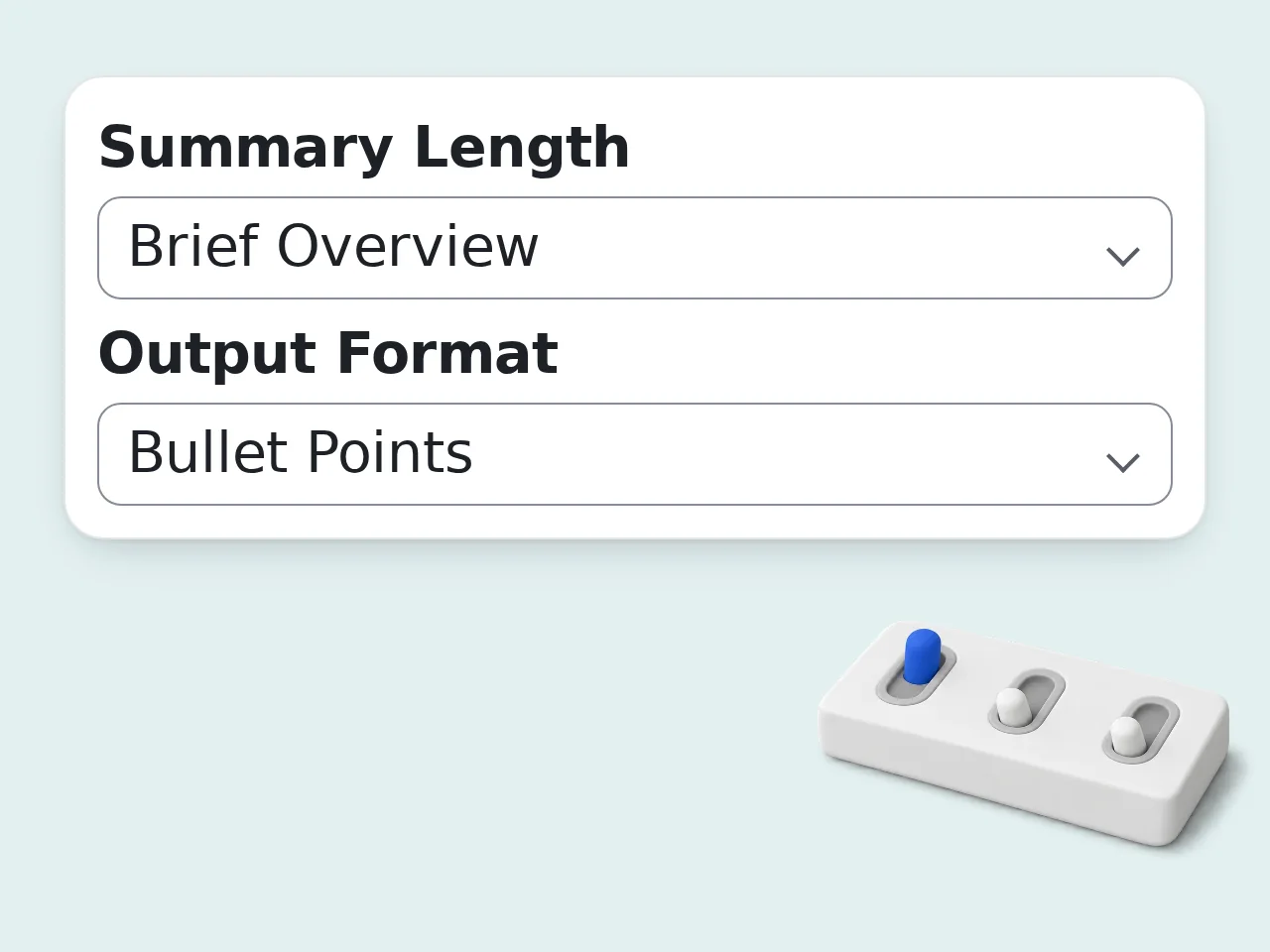
Choose your summary settings
Select your preferred length (brief, detailed, or in-depth), format (bullet points, Q&A, outline), and focus area (exam prep, key concepts, etc.).
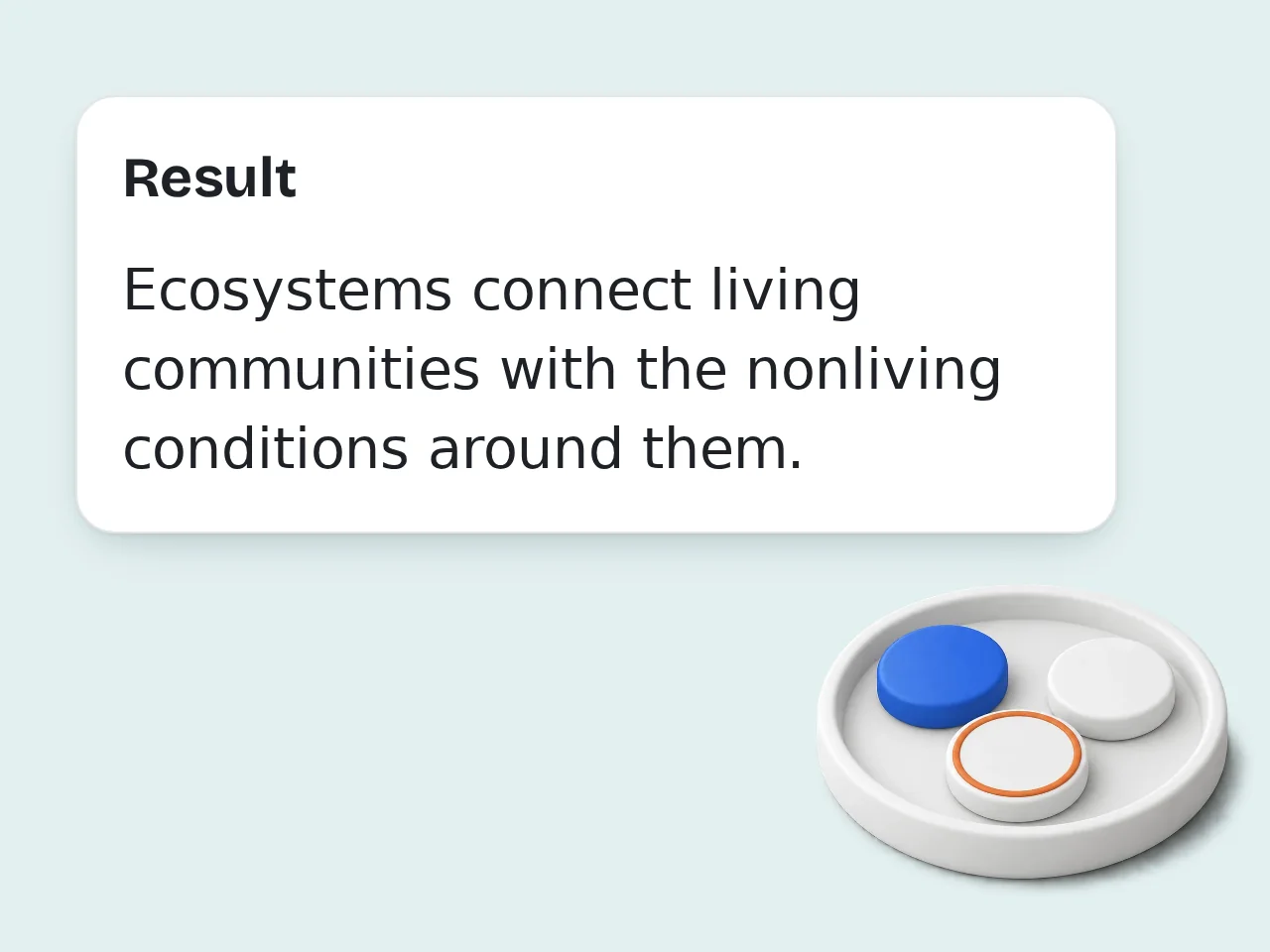
Get your structured summary
The AI textbook summarizer generates your summary instantly. Use it for study notes, exam review, or quick comprehension checks.
Key Features of AI Textbook Summarizer
Everything you need to study smarter, not harder
4 Summary Formats Built In
Get your textbook summary as bullet points, flowing paragraphs, Q&A pairs, or a structured outline. Pick the format that fits your study style.
Exam Prep & Study Note Modes
Switch focus to exam preparation, key concepts, main arguments, or full study notes. The AI textbook summarizer adapts to what you actually need.
3 Explanation Levels
Set the complexity from high school to graduate level. Dense academic jargon gets explained at exactly the depth you need.
Frequently Asked Questions about AI Textbook Summarizer
Common questions about the AI textbook summarizer answered
What is an AI textbook summarizer and how does it work?
An AI textbook summarizer is a tool that reads your pasted textbook content and produces a condensed, structured summary using natural language processing — no manual note-taking required. You paste a chapter or passage, choose your preferred format and length, and the AI identifies core concepts, main arguments, and key details, then rewrites them in a cleaner, easier-to-understand form. It works for any text-based subject: science, history, economics, law, philosophy, and more.
Is the AI textbook summarizer free to use?
Yes, the AI textbook summarizer is completely free to use. Guest users can generate textbook summaries without creating an account, with limited daily free tries — no credit card, no trial period. Free registered users have a monthly credit allowance. Subscribers unlock higher limits and full access to in-depth analysis mode for heavy study sessions. Paste your content and generate your first summary right now. Zero payment information needed. See the pricing page for current details.
How many times can I use the textbook summarizer per day?
Without an account, you get limited daily free tries with the AI textbook summarizer. Create a free account and you get a monthly credit allowance instead — still completely free with no payment required. Subscribers get much higher limits, more than enough to work through an entire semester's reading list without hitting restrictions. Hit your limit? Registering takes under a minute and immediately unlocks more uses at no cost. See the pricing page for current details.
Can I use the textbook summarizer without creating an account?
Yes. No signup, no email, no password required. Open the AI textbook summarizer, paste your chapter content, and click generate — that's all it takes to get your first summary. Guests get limited daily free tries, easily enough to tackle a chapter or two without any friction or registration walls. Need more? Creating a free account takes under a minute and gives you a monthly credit allowance at no cost. See the pricing page for current details.
What subjects does the AI textbook summarizer work for?
The AI textbook summarizer works for any text-based subject. Biology, chemistry, history, economics, psychology, law, philosophy, literature — if you can paste the text, the tool can summarize it. For STEM subjects, set the explanation level to match your course: undergraduate for standard coursework, graduate for advanced material. The tool preserves formulas and technical terms accurately. It does not work well with image-heavy content, math notation that can't be typed, or tables of raw data.
How does the AI textbook summarizer differ from just asking ChatGPT?
This tool is purpose-built for textbook summarization with specific controls ChatGPT doesn't give you by default: summary length presets, output format selection, focus area modes (exam prep vs. study notes), and reading level adjustment. You get consistent, structured output every time without writing custom prompts. For one-off questions ChatGPT works fine, but for systematic study — working through chapters methodically — a dedicated textbook summarizer is faster and more reliable.
How accurate is the AI textbook summarizer?
Accuracy depends entirely on the quality of text you provide. When you paste clean textbook content, the AI textbook summarizer captures key concepts and arguments with high fidelity. It does not hallucinate or add information — it only works with what you paste. If a concept is covered in your text, it will appear in the summary. Always cross-check the summary against your textbook when studying for high-stakes exams. AI summaries are study aids, not replacements for the source material.
What is the difference between Brief, Detailed, and In-Depth summary modes?
Brief gives you a 3-5 sentence core idea — useful when you just need a quick grasp of what a section is about before deciding whether to read in full. Detailed produces 2-3 paragraphs (or 8-12 bullet points) covering all major points — the most practical option for most study sessions. In-Depth gives a comprehensive breakdown with sub-points, examples, and connections between ideas — best for writing papers or preparing for finals on complex material.
How do I get better results from the AI textbook summarizer?
Paste one chapter or section at a time rather than an entire book. Longer inputs spread the AI's attention thin and produce less focused summaries. Match the focus area to your goal: use Exam Prep mode before tests, Key Concepts when learning new material, and Main Arguments for analytical reading. Set the explanation level to match your actual course level. Graduate-level input summarized at high school complexity will lose important nuance.
Can the AI textbook summarizer handle graduate-level academic material?
Yes. Set the Explanation Level to Graduate/Expert and the AI textbook summarizer preserves full technical depth — academic terminology, theoretical frameworks, and complex arguments all stay intact without oversimplification. The tool handles law textbooks, medical study guides, advanced economics, and graduate-level social science readings effectively. For highly specialized content with discipline-specific notation (advanced mathematics, chemical formulas), results are strongest when the source text is primarily prose rather than symbolic notation.
What if the AI textbook summarizer output isn't what I expected?
Try adjusting two settings first: increase the summary length (Brief → Detailed → In-Depth) and switch the focus area to better match your goal. If the output format doesn't suit you, switch from paragraphs to bullet points or try the study outline format — the same content often reads very differently in a different structure. For best results with dense material, break long chapters into shorter sections (2,000-3,000 words at a time) and summarize each part separately.
Does the AI textbook summarizer support multiple output languages?
Yes. Use the Output Language setting in the advanced options to receive your textbook summary in English, Japanese, Chinese, Korean, or other supported languages — even when your source text is in English. This is especially useful for international students studying English-language textbooks who want to review key points in their native language for faster comprehension. The source text itself can be in any language the AI supports — you're not limited to English-only input at all.
Still have questions?
Contact our support teamReady to Summarize Your Next Textbook Chapter?
Paste any chapter and get a structured summary in seconds. Free, no signup needed.